Know your setup’s odds before you risk a dollar.
Write your setup in plain words. SEPT tests it on past 1-minute candles and shows you every trade: the wins, the losses, the worst drop, and when it worked and when it didn’t.
Backtest a setup freeNo code. Hypothetical results on past data, fees not included.
This one failed. That’s the point.
A simple rule — “on the 5-minute chart, a candle closes above yesterday’s high” — tested on NVDA. 958 trades. It looked busy and lost money. Better to learn that from a backtest than from your account.

- 1
Your rule, in plain words (the setup line at the top).
- 2
Read this first: every report says what the test does and doesn’t include.
- 3
Win rate with its loss size: never one without the other.
- 4
Net result and worst drop, not just the gains.
Every trade, every drop, every streak
The account curve shows the drop from each high shaded in red. Below it: largest win and loss, days won and lost, and the longest losing streak, so you know what living with this setup would feel like.
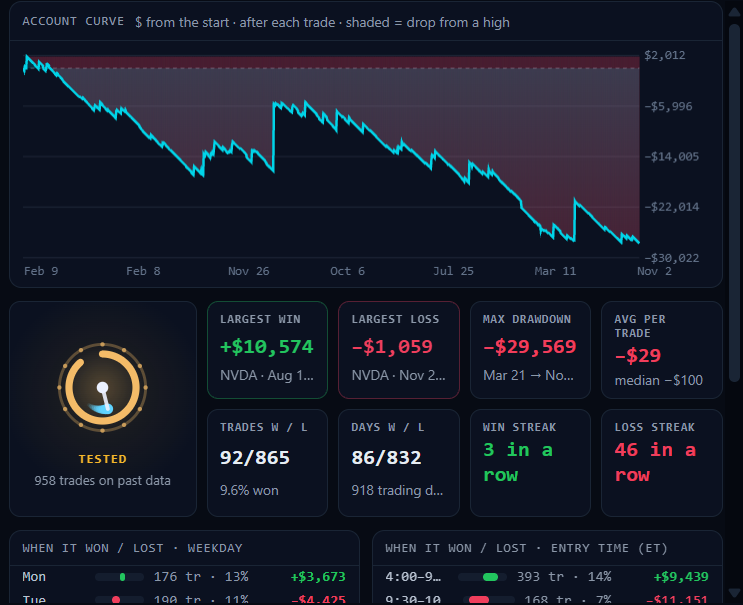
- 1
Account curve, sized to your account and your risk per trade.
- 2
Max drawdown: the deepest drop from a high.
- 3
Loss streak: 46 in a row. Could you have kept following it?
When it worked, and when it didn’t
SEPT breaks the same trades down by weekday, entry time, holding time and how far price moved for and against each trade. That’s where the fix usually shows up.
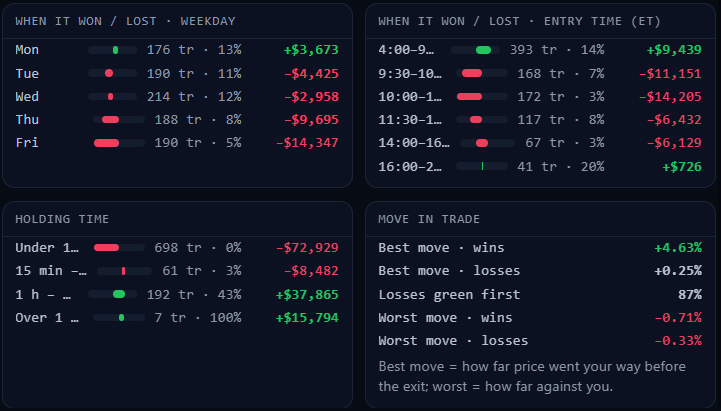
- 1
Entry time: the opening hour lost the most.
- 2
Holding time: quick trades lost; longer holds were the only groups that made money.
- 3
Losses green first: 87%. Most losing trades were in profit before they turned.
From a sentence to a tested setup
Write it in plain words.
“Price touches yesterday’s low and buying beats selling on the 5-minute.” No code.
Pick stocks and risk.
One stock, a watchlist or a screener; your account size and risk per trade.
Run it.
Every trade, on past 1-minute candles, with the same rules and data as the live engine.
Fix it, then prove it on paper.
Change one line, test again, then let Full Autonomous Trading run it on SEPT paper in real time before any real money.
See a real setup that didn’t work →A backtest you can trust is one that shows the bad parts
Same rules as live
The backtest uses the same rules and data as alerts and Full Autonomous Trading.
What’s not included, said up front
Fees, overnight candles, and the screener uses the day before.
Losing tests stay visible
You see the bad runs too, not only the good ones.
Do the math before the backtest
Backtesting questions
Is a backtest a prediction?
No. It shows how a rule would have done on past prices. Markets change, and past results don’t predict future results.
Do I need to code?
No. You write the setup in plain words, and SEPT builds the exact rule and reads it back to you before testing.
What isn’t included?
Fees and commissions, overnight candles, and anything the rule didn’t know at the time (the screener uses the day before). The report says this at the top.
How far back can I test?
It depends on your plan; the pricing table shows each limit.
What should I do after a good backtest?
Prove it on paper first. Full Autonomous Trading can run the same setup on SEPT paper in real time, so you can compare live results with the test before using real money.
Test your own setup free
Backtest a setup freeExample only, not a recommendation to trade this or any setup. Backtest results are hypothetical on past data, fees not included. Past results do not predict future results. SEPT provides tools only; all setups and trades are yours.